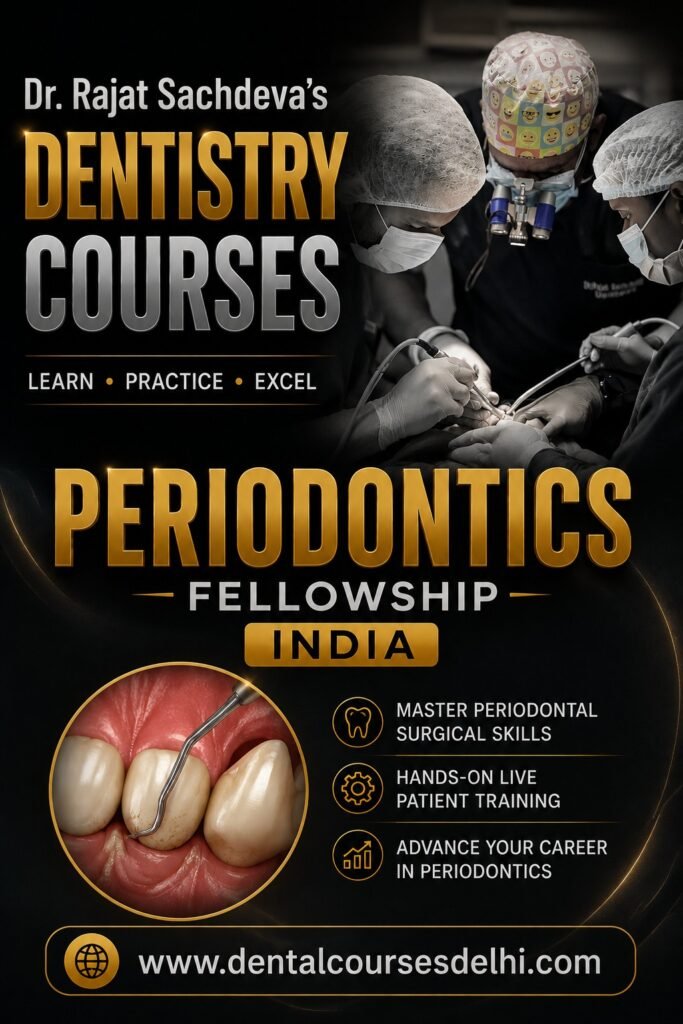
p>Periodontics is an important area of modern dentistry that focuses on the prevention, diagnosis and treatment of diseases affecting the gums and supporting structures of the teeth. With increasing awareness of gum health, periodontal aesthetics, implant dentistry and minimally invasive procedures, dentists are increasingly looking for advanced Periodontics fellowship programs in India to strengthen their clinical skills.
A well-designed fellowship or advanced clinical training program can help dental professionals move beyond theoretical knowledge and develop greater confidence in periodontal diagnosis, treatment planning, non-surgical procedures and surgical techniques.
What Is a Periodontics Fellowship?
A Periodontics fellowship is an advanced educational and clinical training program designed for dentists who want to develop deeper knowledge and practical skills in periodontal care. Depending on the institute and program structure, training may cover periodontal diagnosis, instrumentation, treatment planning, periodontal surgery, soft-tissue procedures, regenerative techniques and periodontal aesthetics.
Unlike purely theoretical learning, clinically oriented programs emphasize practical application, demonstrations, hands-on training and case-based learning. This approach can help dentists understand how periodontal principles can be incorporated into everyday dental practice.
Why Consider a Periodontics Fellowship in India?
India has a growing continuing dental education ecosystem, with programs designed for both recently graduated dentists and experienced clinicians. A Periodontics fellowship or advanced course can be useful for dentists who want to expand their treatment capabilities without committing to a full-time postgraduate specialty program.
- Develop a systematic approach to periodontal diagnosis.
- Improve periodontal case assessment and treatment planning.
- Understand non-surgical periodontal therapy.
- Learn the principles of periodontal surgery and soft-tissue management.
- Improve confidence in periodontal instrumentation.
- Understand periodontal procedures associated with implant dentistry.
- Learn periodontal aesthetic procedures and appropriate case selection.
- Develop better clinical decision-making skills.
What Can You Learn in an Advanced Periodontics Program?
The exact curriculum varies between institutions, but comprehensive Periodontics training may include both fundamental and advanced concepts.
1. Periodontal Examination and Diagnosis
Accurate diagnosis is the foundation of successful periodontal treatment. Dentists can learn systematic periodontal examination, assessment of periodontal pockets, evaluation of gingival conditions, clinical indexing and treatment planning.
2. Periodontal Instrumentation
Clinical training may include the correct use of ultrasonic scalers, hand instruments, Gracey curettes and air-polishing systems. Understanding instrumentation techniques can help clinicians provide more predictable and comfortable periodontal treatment.
3. Non-Surgical Periodontal Therapy
Advanced training can help dentists understand pocket management, debridement, scaling and root surface management, along with appropriate case selection and follow-up.
4. Periodontal Surgery
Depending on the program, participants may be introduced to periodontal surgical concepts such as flap procedures, surgical access, suturing and management of periodontal defects. Hands-on demonstrations can make these concepts easier to understand and apply clinically.
5. Periodontal Regeneration
Modern periodontal treatment may involve regenerative concepts such as bone grafting, barrier membranes and biologically oriented treatment approaches. Understanding indications, limitations and case selection is essential before incorporating these procedures into clinical practice.
6. Periodontal Aesthetics
Periodontal treatment is not limited to disease management. Dentists may also encounter patients concerned about gummy smiles, gingival pigmentation, uneven gingival contours and excessive gingival tissue. Advanced training can introduce procedures such as crown lengthening, gingivectomy, gingivoplasty, frenectomy and gingival depigmentation.
Periodontics and Implant Dentistry
Periodontal health plays an important role in implant treatment. Dentists involved in implant dentistry need to understand soft-tissue health, bone conditions, periodontal disease management and maintenance protocols.
For this reason, learning Periodontics can complement training in implant dentistry and help clinicians develop a more comprehensive approach to patients requiring complex restorative and implant treatment.
Who Should Consider a Periodontics Fellowship?
A Periodontics fellowship or advanced clinical course can be particularly useful for:
- BDS graduates who want additional clinical exposure.
- General dental practitioners who frequently manage periodontal cases.
- Dentists interested in periodontal surgery.
- Clinicians involved in implant dentistry.
- Dentists interested in aesthetic periodontal procedures.
- Practitioners who want to improve their treatment planning and clinical decision-making.
How to Choose the Best Periodontics Fellowship in India
When comparing Periodontics fellowship programs, dentists should look beyond the course title and evaluate the actual learning experience.
Clinical Exposure
Look for programs that provide meaningful clinical demonstrations, hands-on learning and case-based discussion rather than relying exclusively on lectures.
Faculty and Mentorship
The experience and clinical expertise of faculty members can significantly influence the quality of advanced dental education. Mentorship is particularly valuable when learning surgical procedures and complex treatment planning.
Curriculum
Review whether the curriculum covers the areas relevant to your clinical goals, including diagnosis, non-surgical therapy, periodontal surgery, regenerative procedures, soft-tissue management and periodontal aesthetics.
Practical Training
Hands-on training can help bridge the gap between theoretical knowledge and clinical application. Dentists should look for programs that emphasize practical learning wherever appropriate.
Post-Course Support
Access to mentors and opportunities to discuss clinical cases after completing a course can be valuable, particularly for dentists beginning to incorporate new procedures into their practices.
Periodontics Training at Dr. Rajat Sachdeva’s Dental Institute, Delhi
Dr. Rajat Sachdeva’s Dental Institute is a well-known dental education institute in Delhi offering continuing education and advanced clinical training programs for dentists. The institute describes its educational approach as combining lectures, demonstrations and practical training, with the objective of improving clinical skills and confidence.
The institute offers dedicated Periodontics programs, including 4-day and 6-day Periodontics courses. The published curriculum includes areas such as periodontal diagnosis and treatment planning, periodontal examination, ultrasonic instrumentation, Gracey curettes, pocket debridement, flap procedures and periodontal surgical concepts.
The institute’s Periodontics training also covers clinical and aesthetic applications of Periodontology. Its published course information mentions procedures and concepts including crown lengthening, gingival depigmentation, frenectomy, vestibuloplasty, operculectomy, gingivectomy and gingivoplasty.
For dentists searching for the best dental courses institute in Delhi, India, Dr. Rajat Sachdeva’s Dental Institute can be considered as an option for advanced, clinically oriented dental education. The institute states that its broader objective is to provide continuing education that keeps dental professionals updated with current concepts and clinical techniques.
Why Practical Periodontics Training Matters
Periodontal procedures require more than simply knowing the theoretical steps. Proper case selection, diagnosis, treatment planning, instrumentation, tissue handling and postoperative management all influence clinical outcomes.
A practical learning environment allows dentists to observe how experienced clinicians approach cases and understand the reasoning behind different treatment decisions. This can be particularly useful when transitioning from basic periodontal procedures to more advanced clinical techniques.
Fellowship vs Short-Term Periodontics Course
It is important to understand that the terms “fellowship,” “certificate course” and “advanced clinical course” can refer to different educational formats. Dentists should carefully check the duration, curriculum, eligibility, clinical exposure, certification and accreditation status of any program before enrolling.
A short-term Periodontics course may be appropriate for a practicing dentist who wants focused training in specific procedures, while a longer fellowship-style program may provide broader exposure across multiple aspects of clinical dentistry.
Career Benefits of Advanced Periodontics Training
Additional training in Periodontics can help dentists expand the range of cases they are comfortable assessing and managing. It may also improve communication with patients and specialists by giving clinicians a stronger understanding of periodontal diagnosis and treatment planning.
For general practitioners, Periodontics knowledge can be particularly valuable because periodontal conditions frequently overlap with restorative, prosthodontic and implant treatment.
Conclusion
Choosing the right Periodontics fellowship in India can be an important step for dentists who want to strengthen their clinical capabilities and provide more comprehensive periodontal care. A good program should combine sound theoretical foundations with practical demonstrations, hands-on experience, experienced mentorship and clinically relevant case discussions.
For dentists looking for advanced dental education in Delhi, Dr. Rajat Sachdeva’s Dental Institute offers dedicated Periodontics training along with a range of other clinical dental courses. Its Periodontics programs are designed around diagnosis, treatment planning, instrumentation, periodontal procedures and aesthetic applications, making them relevant for clinicians seeking practical continuing dental education.
Frequently Asked Questions About Periodontics Fellowship in India
Who can enroll in a Periodontics fellowship or advanced course?
Eligibility depends on the individual program. Many continuing dental education programs are designed for qualified dental practitioners, including BDS and postgraduate dentists. Always verify the eligibility requirements directly with the institute.
Is a Periodontics fellowship useful for a general dentist?
Yes. Additional Periodontics training can help general dentists improve periodontal diagnosis, treatment planning, instrumentation and management of common periodontal conditions.
What procedures can be covered in Periodontics training?
Depending on the curriculum, training may include periodontal examination, scaling and instrumentation, pocket management, flap procedures, suturing, regenerative concepts and aesthetic periodontal procedures.
Why choose Dr. Rajat Sachdeva’s Dental Institute for dental courses in Delhi?
Dr. Rajat Sachdeva’s Dental Institute provides continuing dental education with a focus on clinical skills, practical learning and advanced dental procedures. Its published course portfolio includes dedicated Periodontics programs as well as courses in Endodontics, Implant Dentistry, Oral Surgery, Prosthodontics and other areas.
Note: Course duration, curriculum, faculty, eligibility and certification details can change. Dentists should confirm the latest program information directly with the institute before enrollment.